
Olathe, KS · Garage Door Service
Garage Door Off Track? Here's What's Actually Going On
Olathe Garage Door Pros fixes doors that have jumped track on the 1960s-70s rollers and hardware common across Olathe's older subdivisions. Same hardware, real fix.
- Repairs & new doors
- Springs & openers
- Serving 8 nearby communities
How We Fix It
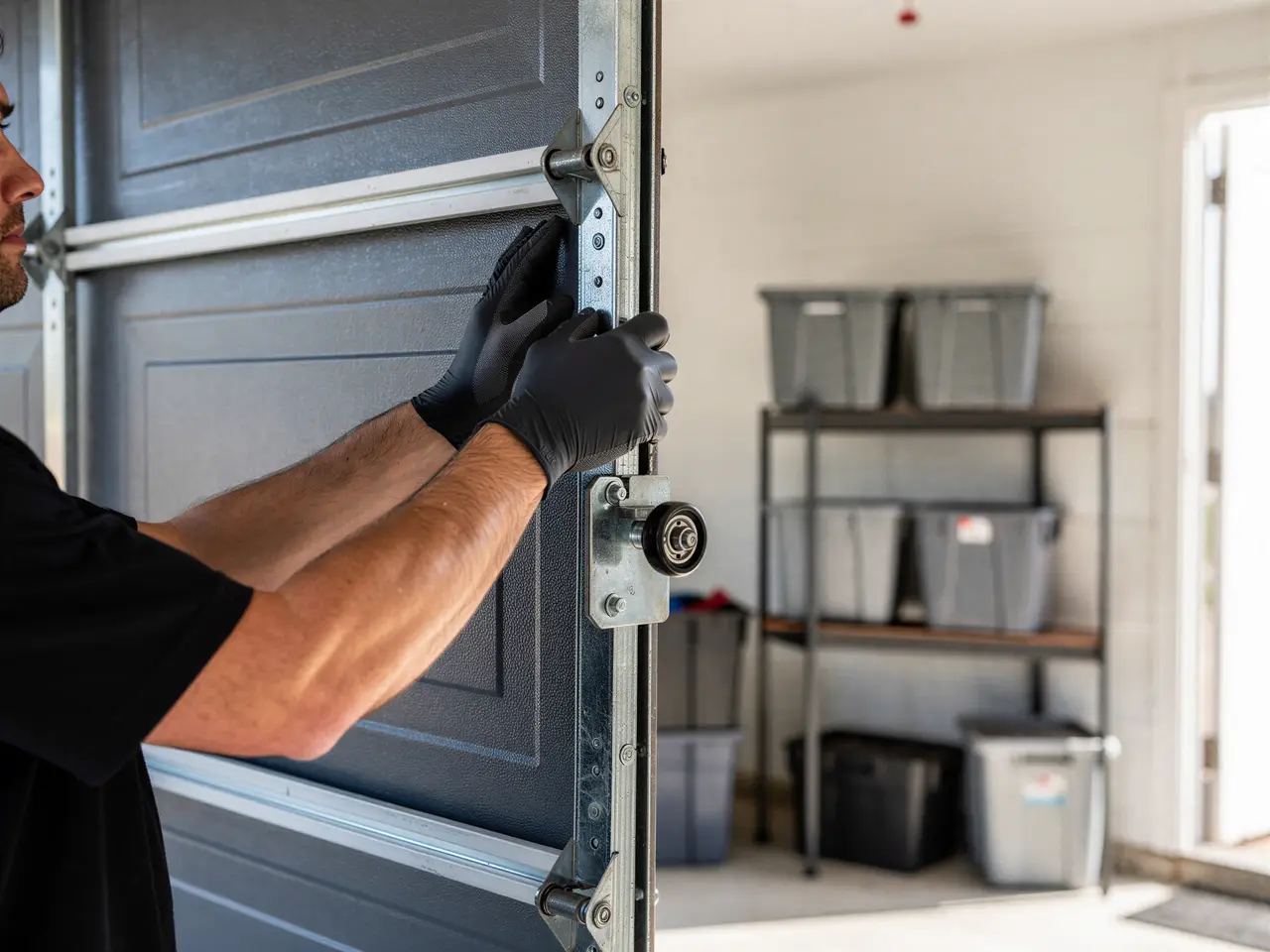
When a door comes off track, the first thing we do is stop anyone from running the opener again. Forcing it with the button bends the track further and can snap a cable or pull a panel loose. We pull the car out of the way if it's blocking the door, release the opener arm by hand, and look at where the rollers actually sit against the rail.
Most of the time on the doors we see across this service area, it's one roller that's jumped the track near a bent section, not the whole door off both sides. We re-seat the roller, check the track alignment with a level, and straighten or replace the bent section - bent track almost never goes back perfectly true, so we replace rather than hammer it back into shape when it's kinked at a joint.
If the door came off because a cable snapped or a spring let go, that's a separate repair and we'll say so before we touch anything, since forcing a door back onto track with a broken cable under tension is not a job to rush. Once the door is re-hung, we run it through a few full cycles by hand and then by opener, checking for binding, before we call it done. We don't paint over a bad alignment just to get the door closing for the night - if the track itself is bent at the drum or near the header, we tell you that's the part that needs replacing, not just adjusting.
What You Are Seeing
A door off track usually shows up as one corner sitting lower than the other, a visible gap between the roller and the rail, or the door stopping partway and refusing to go further in either direction. Sometimes it's quieter than that - a grinding or scraping sound right before the door hangs up, which is the roller catching the edge of the track instead of riding inside it.
If you can see daylight between the bottom corner of the door and the frame, or the door looks slightly twisted when it's halfway open, that's a track problem, not a spring problem. Springs usually show up as a door that won't lift at all, or one that slams down fast - off track is more of a lean, a stick, or a grind.
Don't keep pressing the opener button once you see this. Every cycle with a roller outside the track chews up the track edge and the roller itself, turning what might be a straightforward re-seat into a track replacement.
What Causes It Around Here
Most of the housing across this service area - the 19 named communities we work in - was built between 1950 and 2004, with the bulk of it going up through the 1960s and 70s. That generation of garage door hardware is light-duty by today's standards: thinner track gauge, rollers sized for a lighter door, and brackets fastened with fewer screws than current code calls for. Fifty-plus years of cycling on that original hardware is enough on its own to loosen a bracket or bow a track section.
Colder winters add to it. In this climate band, the metal track contracts in the cold and the grease in old rollers stiffens up, so a door that was already running a little tight in October can start catching a track edge by January. A slightly out-of-plumb track that was fine in warm weather suddenly has less margin for error once everything's contracted.
We also see it after someone backs into a closed door, even a glancing hit - on a track system that's already 40-50 years old, one bump is often what finally bends it past the point of self-correcting.
Can You Do This Yourself
If it's one roller just barely off the rail near the bottom, and the track itself isn't visibly bent, some owners can carefully pop it back by hand with the opener disconnected and the door manually supported. That's about the limit of what's reasonable to do alone.
We'd rather you not try to re-hang a door that's come off both tracks, or one where you can see a kink in the rail, since the door can shift weight unexpectedly while you're working under it. We also don't recommend tackling this on a door that's still connected to a torsion spring under tension - that's not a DIY repair regardless of how old the hardware is.
One honest limit on our end: if the track is original to a 1960s or 70s build, matching brackets aren't always something we can pull off the shelf immediately, and a full track replacement sometimes means a short lead time on parts rather than a same-visit fix. We'll tell you up front if that's the case rather than promise a same-day finish we can't back up.
Frequently asked questions
Why does my garage door keep coming off track in cold weather?
Metal track contracts slightly in cold weather, and grease in older rollers stiffens up. On hardware from the 1960s-70s era common across this service area, that reduced clearance is often enough to let a roller catch the track edge and jump it, especially once the hardware has already loosened from decades of cycling.
Is a door off track the same problem as a broken spring?
No. A door off track usually leans, sticks, or grinds partway through its travel, while a broken spring typically means the door won't lift at all or drops fast. They can happen together if the door jerks hard enough to pop a roller, but they're separate repairs.
Can I keep using the opener if the door is off track?
We don't recommend it. Each cycle with a roller outside the track damages the track edge and the roller further, and can pull a cable or bend the track at a joint, turning a simple re-seat into a full track replacement.
Related services
By Neighborhood
Off Track Repair across the Olathe area
We also handle off track repair in these Olathe-area suburbs.
Book garage door service in Olathe
Call now or request a quote - tell us what the door is doing and where you are.