
Olathe, KS · Garage Door Service
Off-Track Doors in Prairie Village: What 1959-Era Hardware Means for the Fix
Off-track garage doors in Prairie Village often trace to 1959-era hardware - steel tracks and rollers today's parts rarely match. Here's what to check.
- Repairs & new doors
- Springs & openers
- Serving 8 nearby communities
How to Book
We run this job out of Olathe, about 12 miles from Prairie Village, so there's no local branch here and we won't promise a same-hour window we can't back up from that distance. What we can do is take a real description over the phone first: which side the door is leaning, whether it still rolls at all, whether you heard a bang before it stopped moving. That tells us whether to bring a full track kit or just rollers and cable.
If the track is bent more than a few degrees, straightening it on site usually takes longer and costs more than swapping in new track, and we'll say so before the truck leaves rather than after. For the broader list of what we handle in this neighborhood, see our Prairie Village garage door repair page. If you're on the Olathe side of the line and want the base version of this same problem, that's covered on our Olathe off-track page.
Bring the model and approximate age of the door if you know it - for houses built the year most of this area went up, that detail changes which parts we load.
What Causes It Around Here
Most houses in Prairie Village went up around 1959, a good decade and a half ahead of the broader service area's 1950-2004 range with its median near 1977. A door installed when this neighborhood was built usually came with steel tracks on simple roller hardware and either a single extension spring or an early torsion setup - none of it built to the tolerances doors get today, and none of it forgiving of decades of use.
Over sixty-plus years, the brackets holding that track loosen a sixteenth of an inch at a time. Rollers wear flat on one side. Eventually the door walks sideways instead of straight up, and on the worst of these original setups, one hard stop is enough to pop it off the rail entirely.
Cold winters in this part of Kansas don't help. Steel track contracts in low temperatures, and a track that's already a little out of plumb from age closes that gap further, which is when a roller that's been riding rough for years finally catches and jumps. We see more of these calls in houses from this build era than in anything put up after 1990, simply because the hardware itself is older and was never designed with modern clearances.
What You Are Seeing
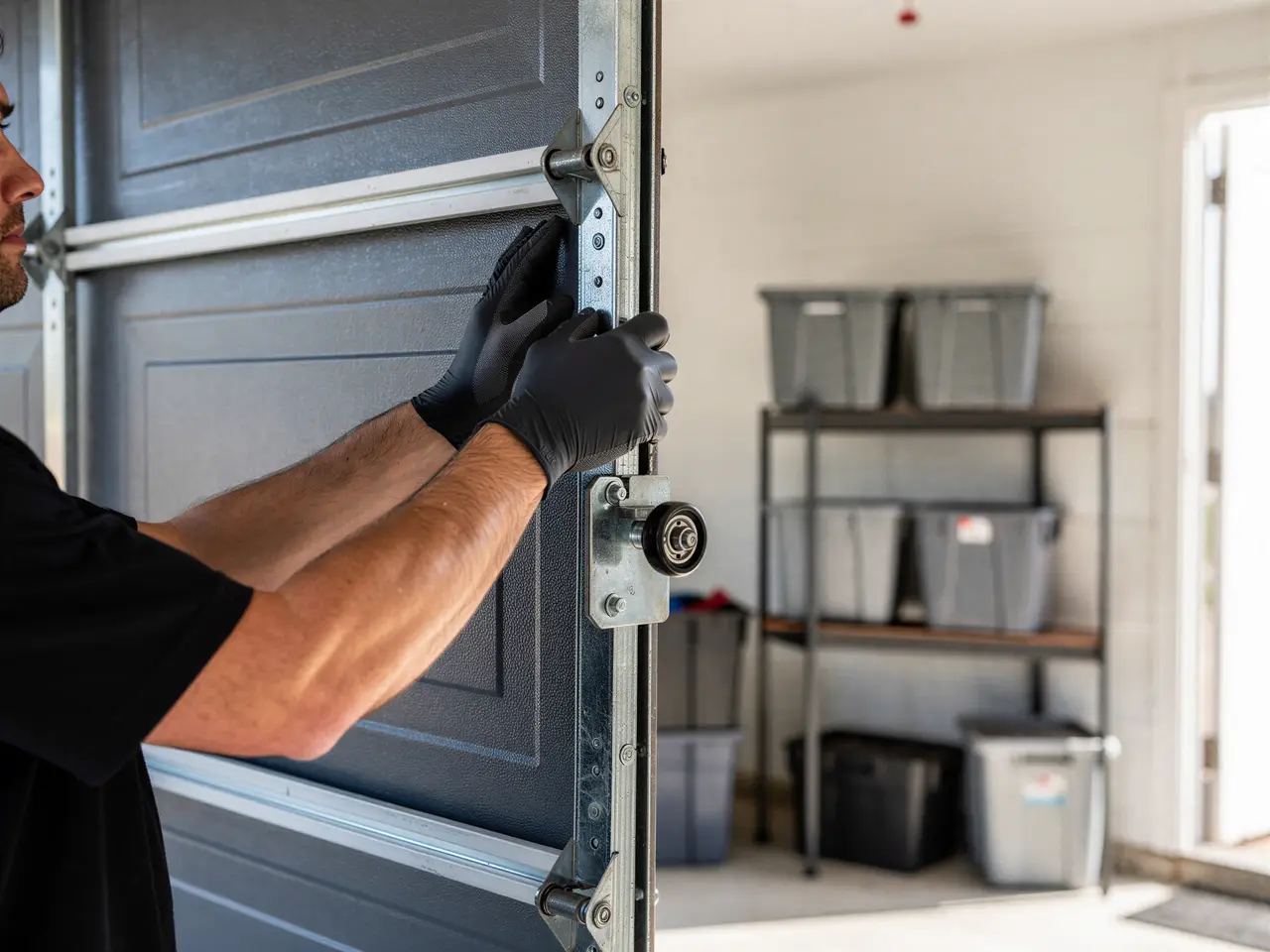
An off-track door rarely just stops cleanly. More often one bottom corner hangs lower than the other, or the door sits crooked in the opening with a visible gap along one side of the frame. Sometimes it's still partway up and refuses to move further in either direction - that's usually a roller that's jumped the rail and wedged the panel against the track bracket.
You might hear it before you see it: a grinding or scraping sound as the door travels, coming from one side only, which is the roller fighting a track it's no longer riding inside of cleanly. On older extension-spring doors from this era, a snapped or frayed cable can also pull a panel sideways and mimic the same symptom, so what looks like a track problem is sometimes a cable problem wearing a track problem's clothes.
If the door came off the rail while someone was driving through or backing out, check the bottom panel and the vertical track near the floor first - that's where the impact usually leaves a dent or a bent section you can see without tools.
Can You Do This Yourself
If the door is down and stable, you can often get a look at the problem without any risk: pull the release cord, lift the door by hand a few inches, and see which side drags or binds. That tells you a lot before anyone touches a wrench.
What you shouldn't do is force a door that's jammed mid-track by yanking it or hitting the opener's remote repeatedly. On the older torsion and extension setups still common in houses from this build era, the spring is holding real tension, and a jammed door means something in that system is already fighting you - prying at it can send a roller or a piece of track hardware flying.
Also worth saying plainly: we don't recommend DIY spring replacement, period, regardless of the door's age. That's not a sales line, it's just where the injury numbers come from in this trade. Track alignment and roller swaps on a door that's already down and off-power are fair game for a careful homeowner with the right tools. Anything that involves disconnecting or compressing a spring is where we'd rather you call.
Frequently asked questions
Why does this seem to happen more in older Prairie Village homes?
Most houses here date to around 1959, well ahead of the service area's broader 1950-2004 range. Doors from that era typically run on simple steel tracks and early spring hardware that's been wearing for over six decades, so brackets loosen and rollers wear unevenly more than they would on a door installed in the last twenty years.
Is it ever okay to just push the door back onto the track myself?
If the door is fully down, unpowered, and the track is only slightly bent, some homeowners can reseat a jumped roller by hand. But if the track is visibly bent, bowed, or the door won't move without resistance, forcing it risks bending the hardware further or injuring your hand near a loaded spring.
Do you keep a truck in Prairie Village?
No. We run this service out of Olathe, roughly 12 miles away, and we're upfront that there's no local branch here. We ask for a clear description of the problem by phone first so the truck that comes out is loaded with the right parts for a door of this age.
Will a repair fix it for good or will it happen again?
That depends on why it came off. A single bent roller or a dinged bracket is usually a clean fix. But on doors from the original 1950s-60s hardware era, repeated off-track events often mean the whole track and roller set is near the end of its life, and patching it repeatedly costs more over time than replacing it once.
More garage door services in Prairie Village
- Garage Door Cable Repair in Prairie Village
- Garage Door Repair in Prairie Village
- Garage Door Service in Prairie Village
- Garage Door Maintenance in Prairie Village
- New Garage Door Installation in Prairie Village
- Garage Door Opener Installation in Prairie Village
- Garage Door Opener Repair in Prairie Village
Book garage door service in Olathe
Call now or request a quote - tell us what the door is doing and where you are.