
Olathe, KS · Garage Door Service
Garage Door Repair in De Soto
De Soto homes mostly date to 1990, a generation newer than the rest of our service area. That changes what breaks and what it costs to fix. We drive out from Olathe.
- Repairs & new doors
- Springs & openers
- Serving 8 nearby communities
The Complications
De Soto doesn't match the rest of our service area. Across the 19 communities we cover, the median home was built in 1977, with stock running from 1950 up through 2004. De Soto skews newer - its housing centers closer to 1990, a solid decade past that regional midpoint. That gap matters more than it sounds like it should.
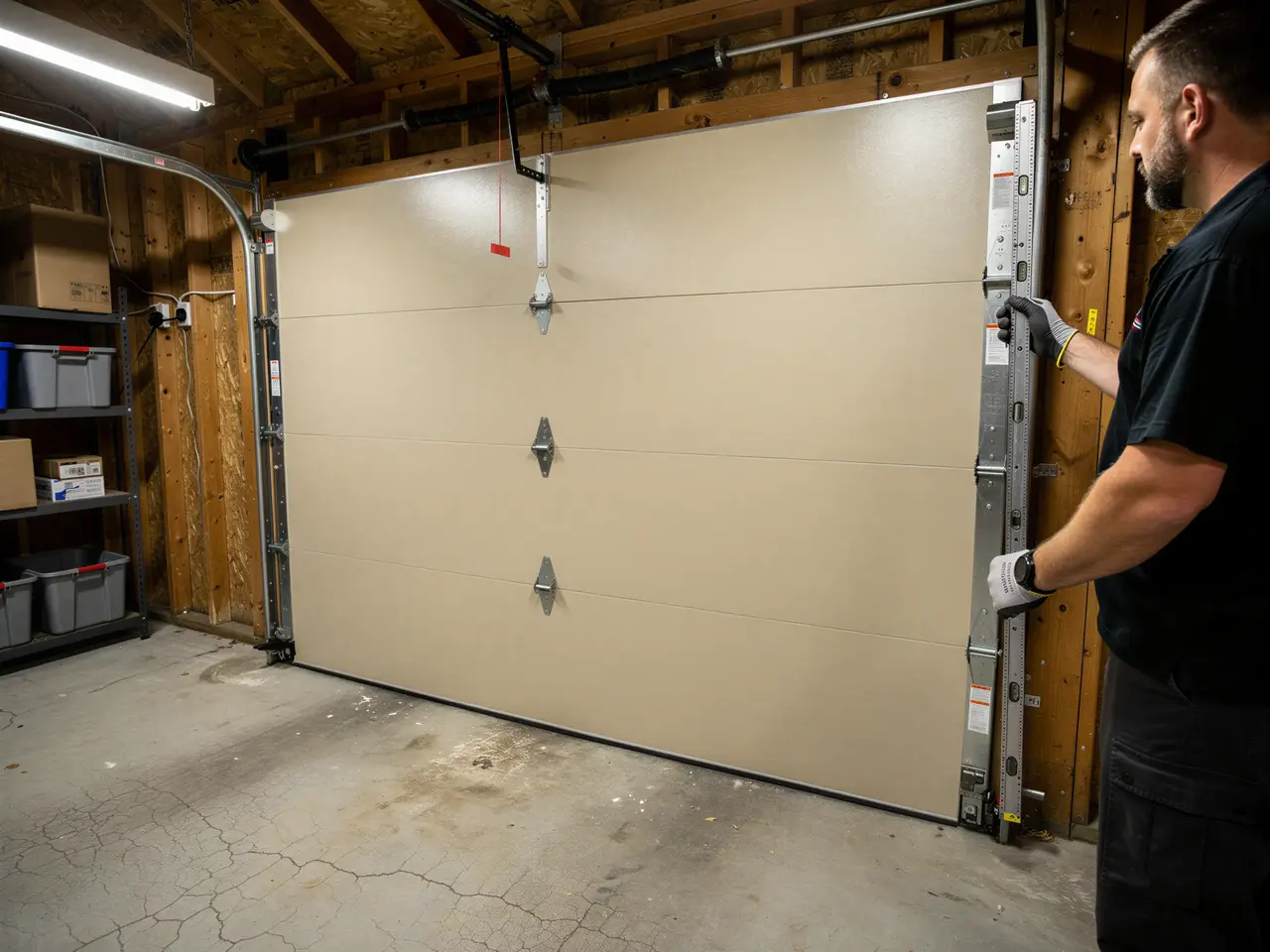
A garage built in the late 1980s or early 1990s almost always came with a steel sectional door on extension springs, not the single-panel or early torsion setups you'd find on an older street elsewhere in the territory. The failure points are different. Extension springs stretch and fatigue rather than wind and snap, and the safety cables that are supposed to catch a broken one are a feature of that era's code, not a retrofit. If yours is missing or frayed, that's the kind of thing that gets overlooked on a newer door because people assume newer means fine.
We also run this area's climate like everywhere else in the region - a cold winter with real freeze-thaw swings. On a 1990s door, that mostly shows up as hardened lubricant and a roller track that's gone stiff rather than outright spring failure, which tends to hit older torsion setups first. The symptoms look similar from inside the garage. The cause and the fix are not the same job.
How We Fix It
We start by figuring out which era's hardware we're actually looking at before we touch anything, because a 1990 door and a 1965 door fail differently and get fixed differently. On the extension-spring setups common to De Soto's housing stock, that usually means checking both springs together - they age at close to the same rate, so if one has gone, the other is usually not far behind, and we'll say so rather than replace just the one that snapped.
We check the safety cables through the extension springs every time, since those are often missing or rusted through on doors this age and it's not something a homeowner can eyeball from the garage floor. Track alignment and roller wear are the other common call on stock from this period, especially after a few winters of freeze-thaw have stiffened the rollers and pulled the track slightly out of square.
If the opener itself is the complaint - won't close, reverses halfway, grinds - we test the travel limits and the safety sensors before assuming the motor's shot. Plenty of 1990s-era openers are still running fine mechanically; it's the sensor alignment or a worn limit switch doing the damage. We're driving out from Olathe for every call here, so we bring what a typical De Soto-era job needs, but we won't pretend to carry parts for every door built before 1990 - some of that older hardware has to be special-ordered.
The Cost of This Job
De Soto's median household income runs about $105,500, well above the $90,982 figure for the wider service area we cover. That's relevant here mainly in what it means for repair-versus-replace decisions: homes in this income bracket more often choose to replace an aging opener or a door with worn-out extension springs rather than keep patching it, where in some of the older, lower-income parts of our territory a repair gets stretched as far as it'll go first.
We're not going to quote a number here we don't have - pricing depends on what's actually broken, the door size, and whether it's a spring job or an opener job. What we can say is that an extension-spring double-door setup from this era is a more standard job than some of the oddball single-panel doors we deal with elsewhere in the region, and parts for 1990s hardware are generally easier to source than parts for something built in the 1950s. That keeps the job itself more predictable, even if we can't put a dollar figure on it in writing.
What You Are Seeing
If your door is slow to close, reverses on its own, or makes a grinding sound partway through the cycle, on a house this age that's usually the track alignment or a roller that's seized up, not a spring that's about to go. Extension springs on a 1990s door tend to fail with a loud bang and the door refusing to lift at all - it won't ease into failure the way an older torsion spring sometimes does.
A door that's heavy to lift by hand, or an opener straining audibly before it gives up, often points to one spring already gone while the other is holding on. That's not a wait-and-see situation - a door running on one working spring puts uneven strain on the opener and the tracks, and that tends to cascade into a second repair call.
If the opener's sensors blink but won't let the door close, check for anything blocking the sensor eyes before assuming it's electrical - that's a common false alarm on garages built in this period, since the sensors sit low and get bumped or dusted over easily. One limitation worth saying plainly: we can diagnose over the phone to a point, but a door that won't move at all needs eyes on it before we can tell you what's actually wrong.
Frequently asked questions
Why does my De Soto house have a different type of garage door than my cousin's place in an older part of the service area?
It comes down to when the houses went up. De Soto's homes mostly date to around 1990, while a lot of the rest of our service area runs closer to a 1977 median with stock going back to 1950. Newer construction here means steel sectional doors on extension springs, not the older torsion or single-panel setups found in older neighborhoods nearby.
Do you have a shop in De Soto?
No. We're based in Olathe, about nine miles away, and we drive out for calls here. We don't keep a branch or depot in De Soto, so we can't promise a specific arrival window in this answer - that gets worked out when you call.
Is it worth replacing both springs if only one broke?
Usually, yes, on a door this age. Extension springs installed at the same time wear at close to the same rate, so if one has snapped, the other is typically close behind. Replacing both avoids a second service call a few months later, though we'll look at the actual wear before recommending it rather than assuming.
Does the cold weather here cause garage door problems?
It's less often a spring-snapping cold snap on a door this age and more often stiff lubricant and a track that's shifted slightly out of square after a winter of freeze-thaw cycles. That shows up as a door that labors or grinds rather than one that fails outright.
Book garage door service in Olathe
Call now or request a quote - tell us what the door is doing and where you are.