
Olathe, KS · Garage Door Service
Why a Door Goes Off Track in an Olathe Garage
Olathe's 1960s-70s housing stock and cold winters push tracks out of alignment in specific ways. Here's what to check before you call it a replacement job.
- Repairs & new doors
- Springs & openers
- Serving 8 nearby communities
What to Check
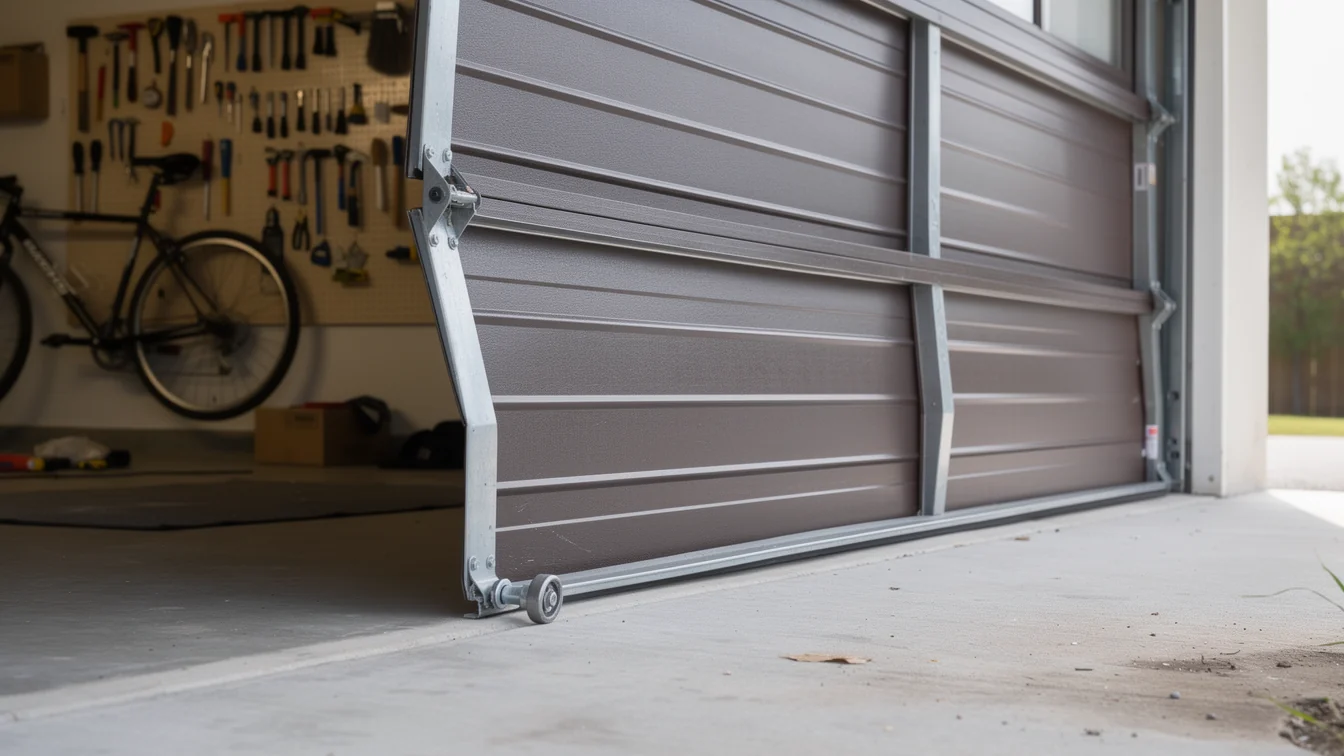
Start at the rollers. On a door built for a house from the 1960s or 70s stock that makes up most of Olathe's neighborhoods, you're often looking at steel rollers in a track that's narrower than what gets installed today. Look for a roller sitting half out of the track, or a track bent inward where someone backed a bumper into the door years ago - that bend is the single most common cause we see on this housing stock.
Next, check the track brackets bolted to the framing. On houses built between 1950 and 2004 (median around 1977 per the housing data for this area), the framing lumber has had decades to shift, and a bracket that's pulled even an eighth of an inch loose will let the track walk sideways every time the door cycles.
Finally, look at the bottom panel where it meets the track. If the door binds there but runs free everywhere else, the track itself is probably plumb but the panel has warped slightly - a different problem than a knocked-loose bracket, and one that usually points toward panel replacement rather than a track adjustment.
None of this requires tools yet. It just requires looking at the right three spots before you guess.
The Situation
Olathe's housing runs mostly from 1950 through the early 2000s, with the bulk of it concentrated in that 1960s-70s band across the named areas in and around town. That matters for track problems specifically because a huge share of these garages still have their original track brackets, original framing, and in plenty of cases the original door - sheet steel that's thinner than what's sold today, hung on hardware that was never upgraded when the opener got swapped out at some point.
A door that's 40 or 50 years old on a track that's never been reset tends to walk off alignment slowly, not all at once. You notice it as a scrape on one side, then a grind, then one day it jumps the roller entirely. By the time it's visibly crooked, the bracket or the track itself has usually already been bent for months.
Newer builds in the area - the smaller share from the 1990s and 2000s - tend to have wider, deeper track and don't show this pattern nearly as often. If your house falls in that older bracket, don't wait for the scrape to turn into a jam.
What the Weather Here Does to It
This area sits in a cold climate band, and that cold does something specific to an already-loose track: steel contracts. A bracket that's marginal in July - holding on by a bolt and some compressed wood fiber - can pull free entirely on the first hard cold stretch of the season, because the metal shrinks slightly and the framing around it has already loosened from decades of seasonal swings.
It's not dramatic. Nobody hears a crack. What happens is the door runs fine in warm months, then starts grinding on one side once the temperature drops, and a lot of owners assume it's the opener or a dead spring. Often it's just the track pulling a few degrees out of parallel because cold tightened one bracket and left another loose.
This is also why winter is the worst time to force a stuck door by hand. Cold steel is less forgiving, and a track that's already out of true will bend further if you muscle a panel past a jammed roller instead of backing off and checking the bracket first.
When It Stops Being a DIY Job
Tightening a loose bracket or popping a roller back into a track you can do yourself, carefully, with the door disconnected from the opener. Past that, we'd rather tell you to stop than have you finish the job wrong.
If the track is bent - not just loose, but visibly curved - it needs to come off and get replaced, not bent back straight. Bent track that's been straightened holds for a while and then fails again, usually worse. If the door is binding on both sides instead of one, you're probably not looking at a track problem at all; that's more often a spring or cable issue, and those carry enough stored tension to hurt someone who doesn't work with them regularly.
And if the house is on the older end of the local stock - original door, original track, decades of small adjustments nobody documented - sometimes the honest answer is that the track isn't the real problem, it's a symptom of hardware that's simply at the end of its service life. We won't sell a track repair on a door that needs to come down.
Frequently asked questions
My garage door only grinds in cold weather - is that a track problem?
Possibly. Cold steel contracts slightly, and a bracket that's marginal in warm months can pull loose once temperatures drop. If the grinding is worse in winter and fine in summer, check the brackets along the track before assuming it's the opener or spring.
Can I bend a garage door track back straight myself?
We don't recommend it. A track that's visibly bent, not just loose, usually needs replacing. Straightening it by hand tends to hold for a while and then fail again, often at a worse moment than the first time.
How do I know if it's the track or the spring?
A door binding on one side, scraping near a single roller, usually points to the track. A door that's hard to lift evenly on both sides, or that slams down fast, points toward the spring or cables - a different repair, and one with stored tension that's not safe to handle without experience.
Related garage door services in Olathe
More garage door guides
Book garage door service in Olathe
Call now or request a quote - tell us what the door is doing and where you are.